AI Phone Ordering for Multi-Location Restaurant Chains
Same brand voice across every store, centralized menu management, per-location call routing, and one dashboard for headquarters. BiteBot scales from 2 locations to 200.
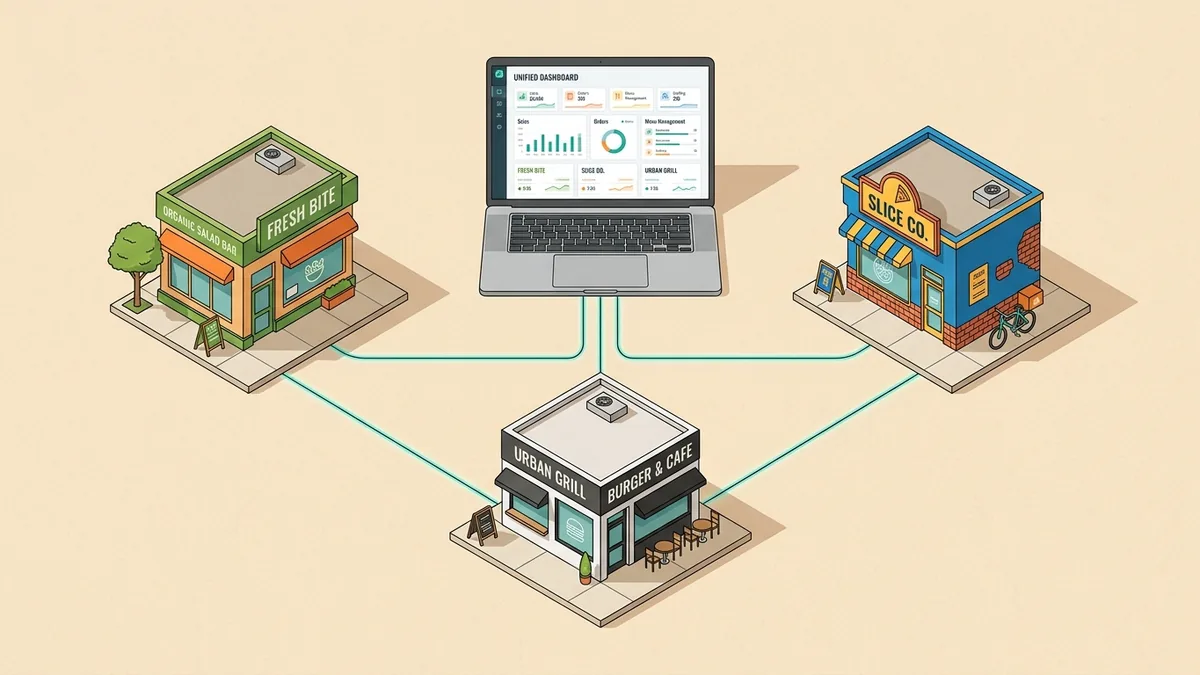
Single-location restaurants can compensate for missed calls with a sharp host stand and tight communication. Multi-location operators can't. By the time a regional manager hears about Tuesday's chronic missed-call problem at the Westwood store, three Friday rushes have come and gone — and the customer who tried to order from Westwood is now a regular at the competitor across the parking lot.
Multi-location chains need three things from a phone-ordering system: consistency (same experience at every store), visibility (centralized data so HQ can see what's happening), and scale (adding store #11 takes minutes, not weeks). BiteBot is built for that.
Why phone ordering breaks down at scale
Single-location: phone rings → host picks up → order → kitchen. One person, one workflow, one feedback loop.
Multi-location: phone rings at each of 12 stores → 12 different hosts of varying tenure → 12 slightly different workflows → orders entered into POS with 12 slightly different conventions → 12 different missed-call rates that nobody at HQ has visibility into.
The variance compounds. At one store the host says "30 minutes" because they always do. At another, the host says "10 minutes" because they think it sounds better. At the third, calls go straight to voicemail after 5 PM. From a brand consistency standpoint it's a slow-motion disaster.
Voice AI fixes the variance because the agent doesn't vary. The same greeting, the same prep-time logic, the same modifier handling, the same closing line — at every store, every shift, every call.
What BiteBot does for multi-location operators
Centralized menu + per-location overrides
A single corporate menu lives in the BiteBot platform. Each store inherits it by default. When a store needs an override — a regional special, a different pizza size lineup, an out-of-stock item — that override is set per-location and only affects that store's voice agent.
Practical example: Corporate menu has "Margherita Pizza." The store at Westwood adds a regional "Westwood Special." Both items are available when calling Westwood; only the corporate Margherita is available everywhere else.
Per-location call routing
Each location gets its own dedicated BiteBot phone number. Calls to Store A's number reach the voice agent loaded with Store A's menu, hours, and prep time. Calls to Store B's number reach a different agent context — same brand voice, different inventory.
Customers calling the wrong number (because they Googled the brand and got the wrong store) are detected and the agent offers to route them: "It looks like you're closer to our Park Avenue location — would you like me to transfer you, or take your order from Westwood?"
One dashboard for HQ
A single BiteBot dashboard shows orders, sentiment, missed-call data, and voice-agent performance across every location. Filter by store, region, or rollup to brand-wide metrics. Spot the Westwood missed-call spike on Tuesday afternoons — and fix it before the next Tuesday — because the data is in front of you, not buried in 12 separate POS systems.
Specific things HQ sees:
- Order volume per location, per hour — heat-map which stores are getting hammered when
- Customer sentiment per location — flagged calls where the AI detected frustration or confusion
- Order-accuracy audits per location — automatic comparison of agent-taken orders against the call transcript
- POS sync status per location — flag stores where orders are failing to land in the local POS
Centralized brand voice control
The greeting ("Thanks for calling Mario's Pizzeria, this is your AI assistant"), tone, and required compliance language are set centrally and applied to every location's voice agent automatically. No store can accidentally drift from brand standards because the standards live in platform config, not in any individual store's training notes.
What integrates
POS-side: Square, Clover, Toast native. Most chains run a single POS system across all locations, so integration is set up once at the corporate level and inherits to every store. Other POS systems supported via order export.
Single sign-on / multi-user permissions: roles are scoped — store managers see their own location's data, regional managers see their region, HQ sees everything. RBAC is on the project roadmap for the next quarter.
When this makes sense
Voice AI is most obviously a fit for multi-location operators where:
- You have ≥3 locations sharing a brand and most of a menu
- Phone orders are >15% of revenue at most stores
- Missed-call rates vary by location and you can't easily diagnose why
- You want to ramp from 5 to 50 stores without proportionally ramping host-stand staffing
Less of a fit if you're a 2-location operation where the same family is on both phones.
Pricing
Multi-location pricing is volume-based. Most chains land on per-location plans with shared menu administration; high-volume groups (50+ stores or >100K calls/month) get custom packaging.
Talk to us about your specific footprint — we'll model the per-location and rolled-up costs and walk through the integration plan for your POS stack.
Getting started
Single-location pilots are the cheapest way to evaluate. Spin up your highest-volume store on the free trial, measure the missed-call recovery and accuracy improvement for two weeks, then decide whether to roll out to the rest of the network.
Most chains we work with start with 1 store, expand to 3-5 stores within a month, and complete the rollout within a quarter. The bottleneck is usually internal change management, not the technology.