If You're Automating Your Restaurant, Start With the Phone
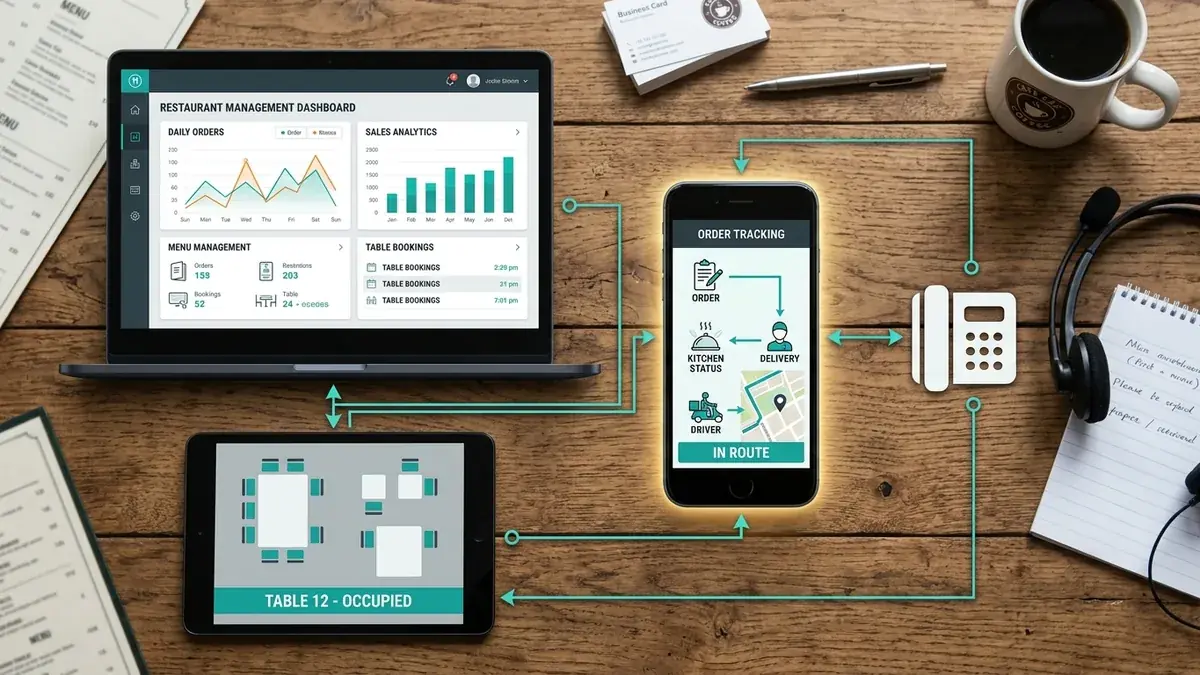
Most restaurant owners thinking about automation in 2026 face the same question: where do you start? The market is full of options — web ordering, mobile apps, kitchen display systems, marketplace integrations (DoorDash, Uber Eats, Grubhub), inventory automation, scheduling software, customer loyalty platforms. Pick the wrong starting point and you spend money on things that don't move the needle. Pick the right one and the rest of the stack falls into place naturally.
This is a framework for sequencing that work. The short version: start with a voice agent on your direct channels, then expand outward to web and app, and only then layer in the marketplaces.
Here's why.
The principle: capture the highest-margin channel first
Every order that comes into a restaurant has a different effective margin, depending on the channel:
| Channel | Typical commission | Net margin to restaurant |
|---|---|---|
| Phone (direct) | 0% (free) | Full |
| Web order (direct) | 0% (you own the site) | Full |
| Restaurant's own app | 0% | Full |
| DoorDash / Uber Eats | 15–30% commission | Reduced |
| Grubhub | 10–30% commission | Reduced |
| In-person dine-in | 0% (but tips, comps) | Full minus front-of-house cost |
If you only had time to fix one of these, you'd fix the one that lets you keep more of every order. That's your direct channels: phone, web, and your own app. The marketplaces are the channel where every dollar you bring in costs you 20–30 cents in commission. The direct channels are where your margin actually lives.
So the automation question is: how do I make my direct channels easy enough to use that customers default to them, instead of opening DoorDash?
Step 1 — Voice agent on your phone line
The phone is the highest-volume direct channel for most restaurants. Even in 2026, restaurants doing $1.5M–$3M a year still see 30–50% of their orders coming through the phone, with the percentage higher for cuisines like pizza and Indian and lower for sushi or modern fast-casual.
It's also the channel that breaks down first when staff are stretched. We covered the operational side of that in When You're Short-Staffed, Let the Voice Agent Take the Calls. For the automation roadmap, the relevant fact is: a voice agent on your existing phone line gets you immediate capacity that doesn't depend on staffing.
It should be the first automation decision because:
- It's the lowest-friction install (forward your existing number; no new infrastructure needed)
- It captures revenue that's currently being lost (missed calls = real dollars, not theoretical)
- It runs every shift without supervision
- Per-order, it's far cheaper than commission-based marketplaces
A voice agent doing 200 calls a month at a flat subscription is in the $2–4/order range. DoorDash on the same volume is $8–$15 in commission per order. The math is not close.
Step 2 — Web ordering on your own domain
Once the phone is handled, the next priority is web ordering. Most restaurants either don't have web ordering at all, or have a generic one buried two clicks deep on a website nobody updates. Both lose customers to the marketplaces.
A direct web ordering page on your own domain — bawarchikitchen.com/order rather than doordash.com/store/bawarchi-kitchen — captures the customers who already know your name, who saw your storefront, who heard about you from a friend. They're going to order from you. The question is just whether they're going to order via DoorDash (and you keep 70 cents on the dollar) or via your own site (and you keep 97 cents).
Web ordering also doubles as the digital menu the voice agent references — the same menu structure powers both. You build the menu once, and it appears in both surfaces.
Step 3 — A native mobile app
App ordering is the third direct channel. It matters most for restaurants that have a base of regulars: customers who order from you weekly or more. Those customers don't want to scroll through DoorDash. They want one tap to "the usual."
A native app is also where loyalty actually works. DoorDash loyalty programs accrue to DoorDash, not to you. Your own app is your customer relationship — the order history, the favorites, the payment method on file, the push notification when a new menu item drops.
Web first, app second is the right sequencing for almost everyone, because web ordering captures the long tail (one-time and occasional customers) while the app captures the regulars (high-LTV customers). You need both eventually; web is the bigger wedge to start.
Step 4 — External marketplaces (DoorDash, Uber Eats, Grubhub)
After the direct channels are working, add the marketplaces — but treat them as customer acquisition, not ordering infrastructure.
The marketplaces are the right tool for finding new customers (people who don't know your restaurant exists yet). They're the wrong tool for serving existing customers (people who already know you and would have ordered direct if it were as easy).
Once your direct channels are solid, the strategy becomes:
- Marketplace order arrives → fulfill it normally, treat it as paid customer acquisition
- Insert a voucher in the bag offering a discount on the customer's next direct order
- Repeat customer → migrates to your direct channels over time
You'll always have some marketplace volume. But ideally it's a slowly shrinking percentage of your total orders, not a growing one.
What "all of this together" looks like
When the stack is fully assembled — voice agent, web ordering, mobile app, marketplace integrations — every order channel routes into the same kitchen ticket queue:
Phone (BiteBot voice agent) ──┐
Web order (BiteBot menu)   ───┼──→ Single order queue ──→ Kitchen
Mobile app                    ──┤                            │
DoorDash / Uber / Grubhub   ──┘                            ↓
                                                        POS / KDS / printer
The kitchen sees one stream of tickets, not five overlapping tablets to monitor. The owner sees one dashboard with order data across all channels, not separate marketplace portals to log into. The customer sees the channel they prefer; you see consistent operations.
Why this order matters
You could build this stack in any order. The reason to start with voice is that it pays for itself fastest — captured missed-call revenue typically covers the subscription within the first month — and it's the channel that, left unaddressed, leaks the most revenue per day.
Web ordering is a bigger investment for a slower-burn return. Mobile apps require a customer base big enough to justify the build. Marketplaces produce volume but consume margin. None of them have the same "I forgot to call you back" failure mode that the phone does.
If you're going to automate one thing this quarter, automate the phone.
Getting started
Start a free trial of BiteBot — the voice agent and direct web ordering ship together. Add channels (mobile app, DoorDash integration) as your operation grows. The same menu, the same tickets, the same dashboard.
Or if you want to see the missed-call cost on your specific operation first, the ROI calculator gives you a number based on your real call volume and ticket size.