Short-Staffed Tonight? Prepare for Last-Minute Staffing Surprises With a Voice Agent
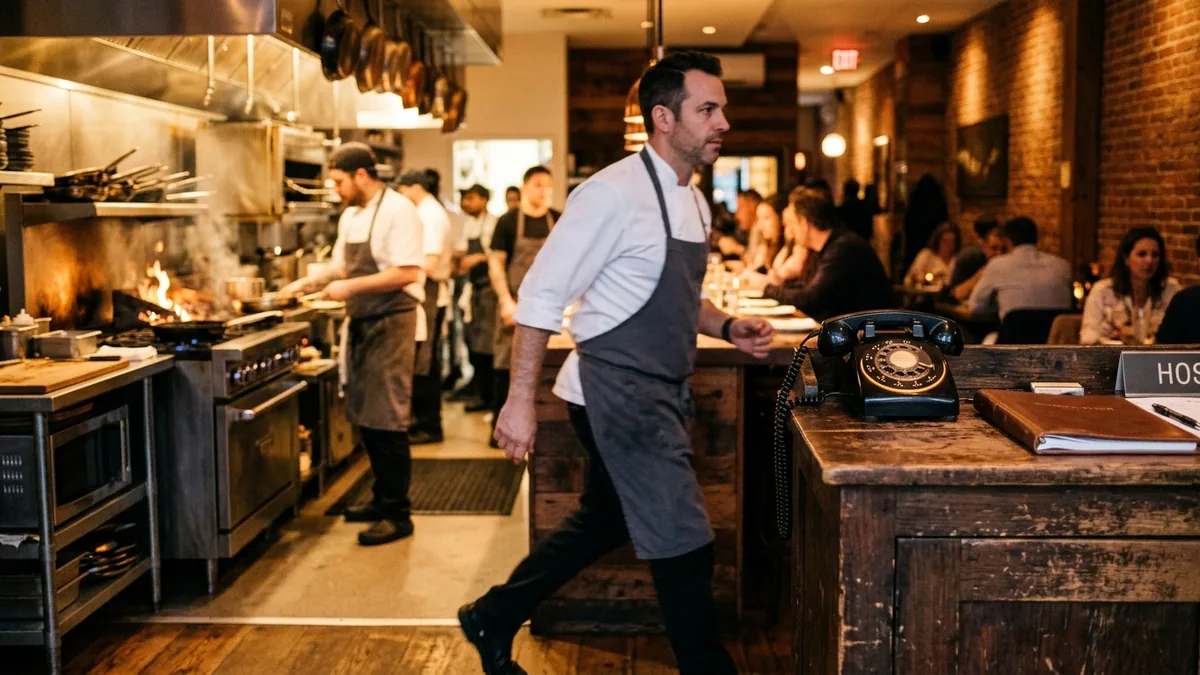
Restaurants in 2026 don't run with a full team. They run with whoever showed up.
A server texts in sick at 4:30 PM. The dishwasher doesn't show. The new hire quit yesterday. By the time dinner service starts, the line is two people short and the front of house is one. The owner — who was supposed to be reviewing food cost variances tonight — is now running the host stand, expediting tickets, and trying to take a phone order with a chef coat on.
It's the same story across the industry. National Restaurant Association data has restaurant labor turnover above 75% annually for years. Most independent operators can't recruit fast enough to keep a roster full. The schedule on paper is a fiction; the schedule that actually walks through the door at 4 PM is what you operate with.
In that environment, the phone is the channel that gets sacrificed first.
What happens to the phone when the kitchen is on fire
When a restaurant is short-staffed, here's the predictable sequence:
Calls go unanswered. With nobody at the host stand, the phone rings 4 times and goes to voicemail. About 80% of customers don't leave a voicemail — they hang up and call somewhere else.
The "please hold" cascade. When someone does pick up, the second call comes in mid-order. The picker-upper says "Can you please stay on hold?" and clicks over. By the time they get back to caller A, caller B has been on hold for 90 seconds; by the time they get to caller B, caller A has hung up and called the place down the street. On a busy night, two-thirds of held calls don't survive. Whoever's hearing hold music is also hearing it from your competitor's phone — and theirs is being answered.
Calls get rushed. Whoever picks up — usually the owner mid-stride between the kitchen and a four-top — is in a hurry. Spice level gets missed. The customer says "no onions" and the kitchen ticket says "extra onions." Cancellations and remakes follow.
Calls become bottlenecks. A single 3-minute phone call from an indecisive customer is 3 minutes the owner isn't expediting. Tickets pile up. The line gets behind. Tables wait longer for food. Reviews suffer.
The owner stops answering. After the third bad call of the night, the phone gets ignored on purpose. The opportunity cost of every unanswered call gets rationalized away. "We're slammed anyway."
The math on this is brutal. A restaurant doing $2M/year that loses 25% of its phone-order revenue due to staffing-driven missed calls is leaving roughly $80K–$120K on the table annually. Not from food cost, not from rent, not from labor cost — from the simple fact that no one had the bandwidth to pick up the phone.
Why "hire someone to answer the phone" doesn't work
The obvious answer is to hire dedicated phone staff. It doesn't pencil:
- A part-time phone person costs $300–$500/week burdened
- They're sitting idle most of the shift (calls are bursty, not continuous)
- They quit. Restaurant turnover is 75%+. Whoever you hired in March is gone in May.
- During the slammed periods when you actually need them, they get pulled to the floor anyway
This is the labor-leverage problem in restaurants generally — fixed-cost labor doesn't match variable-volume demand. You either over-hire (and bleed margin during slow periods) or under-hire (and lose calls during peak).
The voice agent as a force multiplier
A voice AI agent inverts this trade-off. It's a fixed-rate subscription, not a per-call wage. It doesn't call out sick. It picks up on the first ring, every ring, including the third one that hits during the same minute. It speaks the menu correctly, confirms the order, and routes the ticket to the kitchen exactly the same way every time.
For a short-staffed restaurant, this means:
The owner stays where the leverage is
When the AI is taking the phone, the owner is doing what only the owner can do: running the line, fixing problems, managing the room. The phone — the most interruptible part of the night — is no longer pulling them out of position every 8 minutes.
The phone is no longer the channel that gets dropped first
The agent picks up every call. A short-staffed Friday becomes a Friday where you actually capture the calls everyone else is missing because their owner is also on the line. While your competitor's owner is mid-pour, yours is taking three calls in parallel.
Ramp-up and ramp-down by hand
Slow Tuesday lunch? The AI handles all of it; staff focus on dine-in. Catering call surge before Mother's Day? Agent forwards specifically catering calls to the owner's cell while handling the rest. Owners can configure which call types route to the agent vs to a human, and that configuration can change shift-by-shift.
Mistakes don't compound
A rushed human takes a wrong order, the kitchen makes the wrong dish, a remake happens 20 minutes later, the customer is unhappy, the table next to them sees the unhappy customer, the line gets further behind. Every mistake during a short-staffed night cascades.
A voice agent reads back every order before ending the call. Mishears get caught at the call, not at the kitchen window. The remake rate at restaurants we work with drops 30–60% in the first month — and the biggest beneficiary is the short-staffed shift, where one remake used to take down the whole rest of the night.
Prepare before the next surprise, not during it
The trap most owners fall into is treating staffing as a problem to solve only when it breaks. Server calls out sick → scramble. Line cook quits without notice → scramble. New hire ghosts the second-week shift → scramble. Each individual incident feels like a one-off, but in aggregate they're the most predictable thing in your operation: every restaurant has a roughly weekly staffing surprise. The only variable is which day.
A voice agent is the highest-leverage way to take that variability off the table — but only if it's set up and ready before the surprise happens. The version where you sign up at 5:15 PM after the no-show texts at 4:30 is fine, but stressful. The version where the agent is already provisioned, your menu is already loaded, and your line is already conditionally forwarding is a non-event.
Practically:
- Configure once, use anytime. Set up BiteBot during a slow afternoon. Forwarding is a single carrier setting (5 minutes on Verizon / AT&T / T-Mobile). Then it sits ready.
- Pick your "panic-mode" trigger. Some owners flip forwarding on every shift; others only on shifts that go below their staffing threshold. Either is fine — what matters is the decision is one tap, not a 90-minute setup while service is starting.
- Pre-decide which call types stay human. Catering inquiries, dietary questions, complaint resolution — these can route to a human even when normal orders go to the agent. Configure that boundary once.
- Test it on a calm night first. Take 5–10 real test orders. Make sure the agent sounds like your restaurant, not a generic robot. Adjust greeting + menu vocabulary. Then it's there for whenever you need it.
The owners who stay calm during staffing surprises aren't the ones with magical recruiting pipelines. They're the ones who have already automated the most interruptible parts of the night, so a no-show doesn't cascade into a missed-revenue night.
What to do about it tonight
If you're reading this on a slow afternoon before a short-staffed dinner shift, the practical step is to set up a voice agent before the rush starts:
- Sign up for a free trial — provision a phone number, load your menu
- Forward your existing line to the BiteBot number for the night (a 5-minute Verizon / AT&T setting)
- Take a few test calls yourself to make sure the agent sounds right
- Run dinner service with the phone covered
You can revert at any time — the call forwarding is a single setting on your existing line. But after the first short-staffed night where you didn't have to scramble, most owners don't go back.
The bigger picture
Labor shortages aren't going away. The restaurant industry has been on a multi-year decline in workforce participation, and the structural factors (immigration, demographics, pay competitiveness vs adjacent industries) aren't reversing fast.
The operators who keep growing through this aren't the ones hiring more people. They're the ones figuring out which channels can be automated reliably — and the phone is the easiest, highest-leverage place to start. See If You're Automating Your Restaurant, Start With the Phone for the broader framework.
The kitchen is where your craft lives. The phone shouldn't be where your night dies.
Try the ROI calculator to see what a normal-week missed-call rate (just the calls that go unanswered, before staffing crises) is costing you. Multiply that by 1.5–2x for the nights you're short, and the case is usually obvious.